Thursday, December 5, 2013

The Chilly Bone Express


Arizona has been a state of encounters more than it has been one of scenery. It’s a beautiful state in numerous ways, but the sights are often trumped by encounters with the people within its borders. People carry an intense demeanor, regardless of which direction they choose to focus their intensity. Some have been overly helpful or interested, others have been a little more strange than comfort allows, some have stories which don’t seem entirely possible, while others seem focused on one opinion and leave little room for anything else to exist during our encounter. Interactions with others seem to be focused solely on the individual, rather than an area or activity. Whether good or bad, not a single day in Arizona has past without a memorable encounter with a specific individual. Nights seem to be spent holding a up a guard from a person or group, while our lunches are often spent holding conversation with somebody for hours on end.

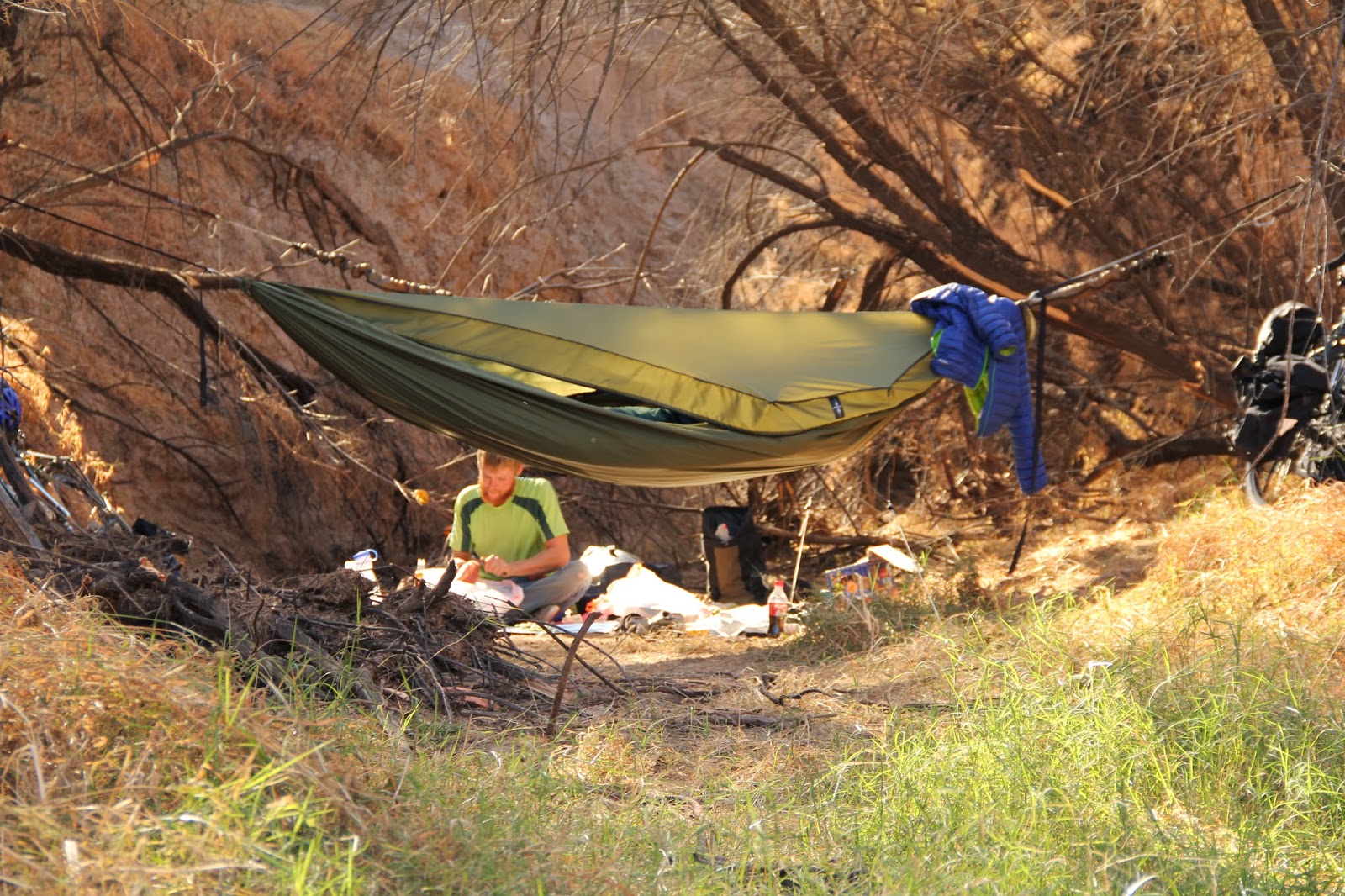
Following our Thanksgiving extravaganza, we spend a night camped out in a community park within Ward 4 of Tucson.  In my opinion, sectioning off city regions into wards already gives me an uneasy feeling normally associated with hospitals and prisons. Topping this feeling, we pedal through the community to find every window and door covered in bars and wire mesh. Some of the mesh seems to be dented in, as if kicked by an unhappy neighbor, leaving rust to occupy the areas exposed by chipped paint. The park is fairly large, leaving us room to place a buffer between the fortified homes and ourselves. I spot a perfect opportunity to hang my hammock within a singular tree, which is something I’ve had my eyes peeled for throughout the entire trip. It takes a few more minutes to set up, yet proves to be worth it after experiencing the view and tactical advantage it will offer if zombies should attack. We finish our dinner and excessive portions of lemon Bundt cake just as people of the night begin to emerge. From across the park, an excessively bright spotlight illuminates our entire area, focusing the center beam directly upon us. It switches on and off occasionally, only illuminating for a couple of seconds at a time and always from a different location within the park. We begin to lose a bit of our patience and begin to spotlight them back. Seeming to be a group of teenagers causing mischief, Wes attempts to approach them with his light in hand. As he draws near, they turn off their torch and scatter into the surrounding bushes. Throughout the night, the light makes a couple more appearances, but only from a distant corner of the park.

A man on a bicycle uses the park’s service road at roughly midnight. His chain creaks with each rotation as his legs seem to pedal out of sync with each other. About fifty yards away, he slows as he notices Wes’ hammock hanging near the ground. He rides to the edge of the park and yells something I’m unable to distinguish, in which Wes replies with an inquiry into what the man is doing.
“Get over here! I wanna talk to you!” the man yells in response.

This alone is enough to keep us on edge for the remainder of the night. Throughout the night, we hear the man going through a large pile of glass bottles, only a hundred yards away. I feel fairly safe in my perch, but Wes is exposed in an open area of the park. I didn’t stick with our plan of being close together for safety and this is the night it seems to be the most necessary. After hours of occasionally peaking out our hammocks to scan the area shapes and figures of the night, we fall asleep into fairly deep states of sleep. I dream of unique hammock locations, but most are cut down, literally, by an unknown man with a machete. The direct Arizona sun wakes us up in the same blinding fashion it will for the coming days. Topping the uneasy feeling of the night, a scrappy soccer ball made of foam has been placed underneath the feet of Wes’ hammock. Unless somebody has an incredibly kick, they must have been within feet of him only hours before. We accept it as a creepy gift and take turns juggling it all morning.

Marana is a town with very little significance amongst the current times. Only a few square miles in area, it offers one park, a mediocre pizza parlor and thousands of homes sandwiched together in roughly nine cookie cutter variations. Its sole purpose is providing homes for those who wish to work in Tucson, yet live outside the city. It offers little more at the moment, but hopes to provide a successful stage for future strip malls, movie theaters and even a waterpark. Its claim to fame was between 1942-’45, when the Marana Airfield was the largest pilot-training facility in the world. During those years, 10,000 flyers were trained to aid in the final years of the Second World War. While some history remnants of the airfield remain, I’ll always remember the town being tied to a conversation with a hot dog vendor.

The groundskeeper of the Marana community park allows us to sleep towards the back of the park after making it very clear that we never talked to him. Before leaving late the next afternoon, we spend the day writing post cards, relaxing in the park and snacking on Clif bars. With only a couple hours of daylight remaining, we begin to pedal towards a taco stand we saw last night. Advertised on a sign with big red letters, the stand seems to be a beacon for those traveling through an otherwise desolate area. Approaching the stand, we have hopes and expectations of grubbing on heaping plates of tacos. Unfortunately, Saturdays are actually hot dog days at this specific stand. We’re open to experiencing a remote hot dog stand in Arizona any day of the week though. Beginning with the mild pepper, which accompanies the hot dog, we start talking to the man operating the vendor. He’s grown up in Marana and seen the rapid housing development in the past decade. “Ten years ago, you could see the base of that mountain,” he says, pointing towards a mass of homes shadowed by mountains. He explains how numerous homes were completed every day during the housing boom. “People couldn’t funnel in fast enough,” he adds. Everything has now slowed down, with many framed homes showing excessive exposure to the elements. The impact is very real to him and it shows on his explanatory face.

With this, his rant begins without any subtle transition. He places the source of all current issues in the hands of the current war and the inability of our bipartisan political system to be effective. It’s the same argument one can find after spending five minutes on the Internet. In this situation, he’s trying to show us that his view is different, because he’s able to link the two using simple numbers. In reality, his points, opinions and the topics being discussed are not the interesting aspect of this encounter. The man could be spouting off to me about the various wheel sizes on vendor carts and I wouldn’t have been more or less interested. What interests me most is his desire to show and prove he has an opinion. He’s fully thought out every aspect of this conversation, covered it from every angle and developed more of a speech rather than a discussion. Our conversation is about him, regardless of how he’s chosen to deliver it, the topic at hand or our input. He has the stage and he plans to use his driving speech to keep it that way. Occasionally, a vehicles pulls up to the stand and chats with him for a bit. We notice he has a sailor’s mouth when speaking Spanish, but only uses clean formal English when speaking with us. “Darn” and “inadequate” certainly aren’t used in his chats with people who stop by to chat with him. Wes and I listen to his ideas as we devour the delicious hot dogs placed in front of us. Getting up to leave, we take the man’s speech with a small grain of salt, but realize it’s another perfect example of the encounters we’ve had in Arizona.

Pedaling through the midpoint of our Arizona route, we find ourselves within the Sonoran Desert. Aside from the Grand Canyon, this is probably the most commonly depicted area of Arizona. One lonesome highway transects an area of vast openness. Surrounding hills seem grand and towering, yet fall behind us easily due to gradual grades. Saguaro cacti are the most notable flora of the area and seem to have taken control of the terrain. With many reaching over thirty feet tall, they seem spaced out over the landscape within equal distances of each other. There doesn't seem to be any patches without the cacti, yet rarely are two seen growing right next to each other. It looks as if people have ventured in to thin out and space the cacti, but it’s all Mother Nature’s doing. Some grow for over 150 years and have numerous arms reaching out from their center structure, yet others never grow arms and are called spears. The arms allow them to take on anthropomorphic forms. One looks as if it’s running towards something, while the next looks like it’s cowering away from the chase. Another looks to be holding its arms out in a hugging embrace, showing love for the area around it. Their spines look intimidating and piercing, yet they’re quite friendly when not pushed on directly. I run my hand up and down the spines of one, allowing them to gently tick between my fingers. Birds land on the arms, most avoiding the temptation to peck at the cacti, and perch atop the tall lookouts without a problem. Sunsets allow the saguaros to become darkened silhouettes, which create an ominous yet welcoming scene. The Sonoran Desert is also the only place in North America known to be the home of jaguars and we keep a watchful eye for them the whole time. Wes’ states it would be the highlight of his trip to see a jaguar and ends up spending an entire evening researching the presence of jaguars in this region. Turns out only three have been spotted in the last twenty years, but we still hold hope throughout our ride through the desert.

“Mind watching my guitar while I go use the restroom?” asks a scruffy looking man carrying a distinct odor. The odor isn’t anywhere near unpleasant, but is definitely distinct enough to be picked out amongst a crowd. There’s a musty presence, mixed with the smoky linger of a campfire. He’s wearing jeans, a khaki pullover and a matching suede hat, with a red bandana tied around his neck. Curly hair flows out the bottom of his hat a couple inches, accompanied by a mustache that seems to be shaved every other time he shaves his beard. Soft and welcoming eyes add to his friendly demeanor. His guitar case is paired with a green canvas army backpack, which seems to complete his traveling attire. As he returns from the restroom he smiles, sits down at a nearby table and strikes up a conversation. He reaches out his hand to introduce himself and I see a letter tattooed upon each finger, but his aged skin has made the letters illegible. “Captain Dingo,” he says, “pleasure to see some fellow travelers out on the road this time of year.” I glance out the window to be blinded by the warm Arizona sun, but realize it’s still the end of November.

Captain Dingo, 63, is a hobo. The real kind of hobo who finds happiness in what he does. He begins the conversation by making sure we know what defines a hobo. He does so by clearing up the misbelief that a hobo, tramp and bum are one in the same. Hobos travel to work, moving around the country or world in search of the next experience. Tramps also hold the desire for travel, but do not combine it with work. Bums have no interest in travel or work; hovering dismally in one area until their days reach an end. Returning from the Vietnam War decades ago, he started a successful taxicab company with his wife in Massachusetts. Unfortunately, within years everything came to a sudden halt, altering the remainder of his life. In 1975, his wife was killed in an automobile accident. Picking up the pieces throughout the following decade, he was sued for all he was worth when one of his drivers killed two people in a traffic accident. Since 1987, he’s been wayfaring from coast to coast, moving from one veteran’s hospital to the next, playing his guitar for the people he believes need it most. Captain Dingo is based out of Phoenix, Arizona, where he was raised and now lives during the winter months. Through the months of April and November, he throws his pack on and moves from rail to rail, until he reaches a chosen destination. Sometimes these destinations involve hobo gatherings, while other times they’re simply a location at the end of the week’s road.

We step outside for a moment as he pulls out his guitar, sits on his army backpack, places his harmonica holder around his neck and gives a tip of his hat to a couple getting out of their car. The woman ignores his gesture as her husband looks slightly past the disheveled man, trying not to make his curiosity apparent. He prefaces the first song by letting us know it’s about his father and brother who both joined the navy years ago. His brother never came back, while his father never let his life steer away from the navy. “Men of Wind and Water” is about men of the service, specifically the navy, who are carved out of something different than other men and live by the movement of water and wind. He stares at my camera while he sings, as if he’s gazing right into my eye, through the lens. “Dumpster Diving Song” is a joyful song accompanied by smiling and a rocking of his torso. He says it reminds him of the sense of community the hobo world shares. Lastly, he plays “Chilly Bone Express” under a softer tone as he looks up at the sky and then back down at his feet repeatedly. The Chilly Bone Express is considered to be the last train a hobo takes as he, or she, is carried off into the afterlife. Reflecting on a life of travel and the experiences gained, the hobo reflects back on whether or not it was all worth it. “Unfortunately, none of those who have passed on were able to carry on that crucial bit of advice before getting on the train. I guess we’ll simply have to keep riding until we know for sure,” he says with a wink and a smile.

I couldn't find the full video, but this one includes a good portion of the “Dumpster Diving Song.”
http://www.youtube.com/watch?v=qfn0fm6tuEY


Friday, November 29, 2013

Dirty Duck Day


For the past few years, I’ve been the guy in charge of the Thanksgiving turkey. Whether for friends, family or a personal desire to eat a whole turkey, I’ve learned that something always seems to go wrong. Personally, I always put it off to the day of the feast, only to realize I should have purchased the turkey and let it thaw in the fridge for the prior two days. Searching the Internet for a miracle solution, I always seem to find a way to thaw out a frozen bird in a couple hours. This year, I’ve focused on prevention rather than last-minute mayhem. We’ve purchased our bird the morning before Thanksgiving and have allowed it to sit out for more than a full day. Due to our situation, “sitting out” means strapping it to the back rack of my Surly and bringing it along for the day’s ride. It only fell off once and seemed to enjoy the cool, yet thawing rays of the Arizona sun. Up and over the pass through Texas Canyon it sat, experiencing the fastest descent of our trip at 47mph. Boulders, sized in comparison to small homes, zip past in my peripheral vision. Somebody has tagged “You are Beautiful!” in soft, swoopy cursive across the entire length of one. A flower, making even the most stern and reserved person smile, dots the exclamation point.
Arriving in Benson, Arizona, we find the perfect location for our loosely planned Thanksgiving extravaganza. Crossing a bridge, into the core of this small town, we cross a desert wash, lined with mesquite trees and long grass, tracked by the seemingly occasionally passing of an off-road buggy. We pass by the wash, towards Safeway, knowing this will be our home for the next 48 hours. The grocery store is packed full of people, many of which approach us asking “You must be the guys with the bicycles out front, huh?”. Walking through each aisle, we’re gathering the food required to satisfy a small family on this yearly day of giving thanks. In the end, we pile everything together outside the store, to find a duck, loaf of bread, three yams, a butternut squash, a bag of green beans, fresh rosemary, a bag of brown sugar, sticks of butter, two apples, a mince pie, aluminum foil, a loaf of French bread, a container of Safeway mac n’ cheese, a bottle of honey, an orange, two cans of cranberry sauce, paper plates, a bag of charcoal, a bottle of orange liquor and a Fat Tire seasonal variety twelver.
My mouth begins to salivate through simply looking at it all. I imagine smashing it all onto a singular plate and then finding a way to get most of it into my mouth. Carefully, we load it onto our, already loaded, bicycles. Everything is carefully placed, or smashed, into its own perfect little nesting place for the couple miles back to our planned home. Wes’ front racks grumble under the base weight required to carry our gear. They now produce a more noticeable and nagging grumble as he loads them with our future meal. My bike looks pudgier than usual, with a loaf of bread being the only item without a secure spot amongst the mess. Right arm becomes the dedicated bread carrier, while the left attempts to control the two-wheeled steamroller. The bridge underpass leaving downtown nearly takes me out, but I pass through it collecting only a rip in the shoulder of my jacket, making it the 87th hole in the jacket. Pushing the bikes through quite a distance of loose sand, through a bend in the wash, we find our home nestled between the steep walls of an inlet canyon. For the first time since we left Bar Harbor, we set up camp with the plan to spend the entire next day in this location. Exploring the surrounding areas, we find trails and paths, narrow and neatly maintained. It’s almost as if the trail was packed in, then manicured by a short man with a leaf blower. Paths are narrow and shrouded over in areas, allowing only 2-3 feet of height clearance. Animal tracks pick up in the sand, where each of the neatly kept trails end, coming down from the steep walls along the wash. The tracks must belong to some precious kit foxes or sugar plum fairies. We hope to get a sight of whatever we may be in the presence of.
It’s a cold night and therefore we both retire to our hammocks fairly early. It only takes a couple New Belgium 1554s and a temperature drop below 30 to get me nestled into my hammock. Listening to the occasional movement of bushes and Wes restlessly rolling around in his hammock, I peak out of my fully-enclosed hammock and see the wash slightly lit by the last third of the waning moon. It keeps the trees, bushes and sky a deep black, while making the wash an illuminated path through it all. As I drift off to sleep, I notice condensation forming in my hammock, but my level of comfort limits me from creating any sort of venting to prevent it from continuing. I’d rather wake up in a puddle of condensed liquid than unzip my sleeping bag for a moment.
There’s a sniffing and crunching of branches on the hillside towards the foot-end of my hammock. I lay silent and listen to the movement of whatever is out there. We saw quite a bit of trash and clothing up on the hillside, about thirty feet above us. Remnants of a few makeshift homes, and the materials that make them, are scattered above. I lay there, wondering if this is a person or curious animal. These encounters raise the hair on the nape of my neck, because there are really only two likely situations. Either there is a curious animal moseying around our camp or it is a person who has passed the realm of curiosity and has now moved closer to investigate or act. The animals usually create a fun encounter, while the person in that situation will usually not be there with the right intention. Slowly, I unzip my hammock cover and begin to peak out into the night. As I begin to move my head through the opening, I notice the creature of the night has stopped moving. I too stop and slowly begin to reach for my flashlight, which is known for harnessing the power of the sun. The creature of the night will not stick around for much longer. I quickly, but quietly, swing my arm above the ridgeline of the hammock and beam it directly towards the hillside. Two bright red eyes stare at me from roughly fifteen feet away. It tenses up and rocks back in its stance, but doesn’t break its gaze or position. Two feet tall, with coarse and dark hair, it breaks its vision from my flashlight for a second and analyzes the trail ahead of it, enabling me to further make out the features on the creature of the night. Two small, but easily distinguishable, tusks protrude from the mouth of this boar. It softly eases its stance, then turns around and slowly makes its way back up the trail. It does so in a surprisingly agile way compared to how I would imagine a boar would. Bye bye piggy.
Naturally, we wake up in the morning and instantly make spears. We’ve used our knives to whittle the end of some mesquite branches down to sharp and piercing points. In the end, we remember zip-ties are part of our repair kit and we simply fasten our knives to the ends of the branches. We have no intention to hunt boar, but if they have any intention of tusking us, at least we’ll be prepared. Furthermore, while Wes is on a morning walk to get some Coronas, he spots a rough man, kneeling in the long grass, watching me move around camp, through his binoculars, from about a hundred yards away. Wes’ surprises the man with a Thanksgiving greeting, simply to show the man that his presence is know, and the man quickly jerks the binoculars down and returns the greeting, trying to act as if everything is normal. In the end, the makeshift spears serve as dual-purpose boar/human safety devices.
We’ve decided to cook our duck in a fairly unconventional way. The oh-so-conventional convention oven isn’t something we can get our wandering hands on at the moment. Instead, we’ve had a plan for how to cook our Thanksgiving bird since roughly the first week we started planning this trip over a year ago. Sure we could simply slow roast it over a campfire or cook it one piece at a time on skewers, but we wanted to do something unique and memorable. We’ll be cooking our duck in the sand bed of this wash we’ve camped on. There is some prep to get everything ready, but the main task is creating a fire hot enough to keep an area of coals, sand and rocks hot enough to cook a duck for at least three hours once the flames are completely extinguished and covered with sand. Our shoes and socks come off first thing in the morning. The next few hours will be spent digging around in the sand and gathering dead limbs from mesquite trees in the area. The sand is warm on the surface, but shows its cooler side once disturbed with a step or impromptu dance move. All moisture from the surrounding area drains into this wash, creating a bed of damp sand. The coarse granules squish between our toes and create some light abrasion, but it feels good. Digging with our hands until the hole is deep enough to crawl into and dig around my feet, the whole is eventually more than three feet deep. Collecting rocks the size of cantaloupe (us mountain bikers call these baby heads), we create a floor of rocks, then compliment the outer edge with a wall of rocks. At this point, most of the hard work is done and the fun can begin. Wes is endowed with the power of flame and lights a collection of branches, of which I amply doused in gasoline. Regardless of how wrong it may sound, there’s something that feels so right when it comes to the combination of spears, Coronas, hand dug sand pits, copious amounts of gasoline and a lighter.
Teamwork goes into full effect. By afternoon, this fire needs to be hot enough to feel from yards away, which is harder to achieve in a desert wash than it is in the abundantly wooded areas in which we normally have campfires of the controlled nature. Team A is in the constant search for fire fuel while also making annual Thanksgiving calls to family and friends. Team B takes on the role of prep cook and begins slicing, chopping, seasoning, glazing and stuffing all the components of our glorious feast. “I’m ready to switch!” is occasionally yelled, once one of us has endured enough cuts, or coarse sanding of our feet, to want to join the other team for a bit. The fire grows hotter and larger as the hours go by. Wes has taken the core out of two apples and filled them with brown sugar, making me want to bite into them without any cooking. The food prepping area has turned into an attractive hotspot for bees desiring a few nibbles of brown sugar and butter, which covers most of the food. See if you can spot all five bees in the squash photo below. Wes and bees have a hate/hate relationship and therefore I’m delegated to finishing up the prepping, while he becomes the documenter of memories. Bees land on the food I’m cutting, occasionally buzzing to my hands or even giving my nose a quick landing. My approach is to let them be and hopefully they’ll let me be. One of these days it’ll backfire on me. The bees try to accompany the glaze on and inside the duck, but I have no way of explaining to them that they don’t want to be going where this duck is headed. Everything is wrapped in layers of foil, putting more layers on the bottom of the duck, which sits directly on hot coals and rocks. Once the duck is placed in its tailor-made oven, we place a damp towel over it and quickly follow it with all the sand we previously dug out. Within seconds, the hours of digging, fueling and prepping are covered up and unrecognizable as ever occurring. The only distinguishing characteristic of the oven is “DUCK” written and underlined in the sand. Within minutes, we feel the warmth of the coals coming up through the sand as we stand directly above it. This is actually working. Our duck is cooking beneath us, while we employ the out-of-sight, out-of-mind concept.
I enjoy the next couple hours by relaxing by our secondary fire and enjoying a few more seasonal brews. Wes heads back to the store to buy more candy and items to compliment our dinner and desert. Collecting wood for the fire, I snap a branch from a tree, but notice it creates a much greater commotion on the hillside behind it. I look up to find the dark figure of a large boar running off down the trail. I catch it off-guard on the inclined trail, and it seems to send half the hillside tumbling down as it bolts away. I reach back for my spear, but it’s gone from sight and sound within a minute. I crouch low and follow the path for a few hundred yards, but find nothing more than bedding areas and continual routes of intricate trails. Wes also has an encounter with an aggressive boar on the way back from his store run. This place seems to be teaming with boars, but I enjoy its employment of keeping us on our toes.
With only forty minutes remaining before we uncover the duck, we nestle all our veggies around the fire, wrapped in their numerous layers of aluminum foil. Conversations become silly as we sit back and take in the full experience of where we are. The air is crisp, the sand is now cold, the veggies sizzle in their brown sugar and butter baths, occasional scans with the flashlight show pairs of eyes staring at us, the beers are creating giggles and the smell of smoke is mixing with the aroma of food. All is illuminated by the flickering orange hues of our campfire, which drowns out the cool lighting of the faint moon. I’m not one to believe that this is what life is all about. I don’t see gain in complete release or lack of responsibility. I won’t sit anywhere trying to explain that people need to be free, exposed to occasional discomfort or sitting around a campfire with some beers as their duck cooks in the ground, but I do feel that everybody should include a moderate amount of these experiences in their life. It’s moments like this that show me how much one can get out of $40, a few hours in the dirt and a strong friendship to share it with. All the while, our veggies continue to sizzle as the laughs continue on.
Time to uncover it all. One full day of work is coming to immediate fruition within a single minute. Called “dog digging” from my childhood digging on the beach, we plant our feet and begin clawing at the sand as it kicks up into a granular wave behind us. While this may seem alarming or strange, my fingertips begin to bleed, but I’m far too excited to slow down, let alone stop. One clawing is followed by another, then another, which quickly reaches the clawing of an aluminum foil duck. Juggled from one hand to the next, the duck is out and ready to be dished, along with all the veggies and mac n’ cheese one could desire. With two plates of food each, our mac n’ cheese mixes in with our duck as our other plate delivers us our fair share of the butter roasted “healthy” side of our meal. Each dish cooked different and presents itself in a unique way. The yams come with a little bit of char, while the green beans and mac come out perfect, but the star of the show is the squash. Our duck is cooked all the way through, somewhat to my surprise to be completely honest. I’ve had high hopes the whole time, but certainly realized the possibility of failure the whole time. It came out with more of a boiled textured than it did baked or roasted. It’s somewhat strange, but the satisfaction of cooking it in a sand pit makes everything else, including the quality, seem trivial. We lean back in our chairs and dive into our food. At this point in the evening, we normally indulge in a moment of silence until we’ve reached the point of discussing how we can’t fit any more food in our bulging stomachs. With all the work and anticipation put into this meal, you'd think our moment of silence would be even stronger, but once again, the beers and company of a friend make the food seem like the smallest part of our Thanksgiving dinner. Smiles are shared alongside the fire, we begin reminiscing about the last few months as if they were years behind us, laughs overpower our uncertain futures that have stressed the previous weeks and cheers are put up in the air with the mention of any fun, silly, outrageous or thoughtful idea or moment. We’re happy and it takes very little for us to realize this.